UVB phototherapy (311 nm narrowband)

The healing effects of sunlight
The healing effects of sunlight on inflammatory skin conditions have been known since ancient times. This is particularly true of psoriasis in combination with saltwater baths. Specific, invisible parts of the UV spectrum in sunlight (UV-A and UV-B) are responsible for these healing effects. However, excessive exposure to UV-A and UV-B can also lead to sunburn and other acute side effects. Excessive long-term UV exposure also accelerates skin ageing and may increase the risk of skin cancer. In addition to the UV spectrum, the correct dosage is crucial for successful and safe UV phototherapy.
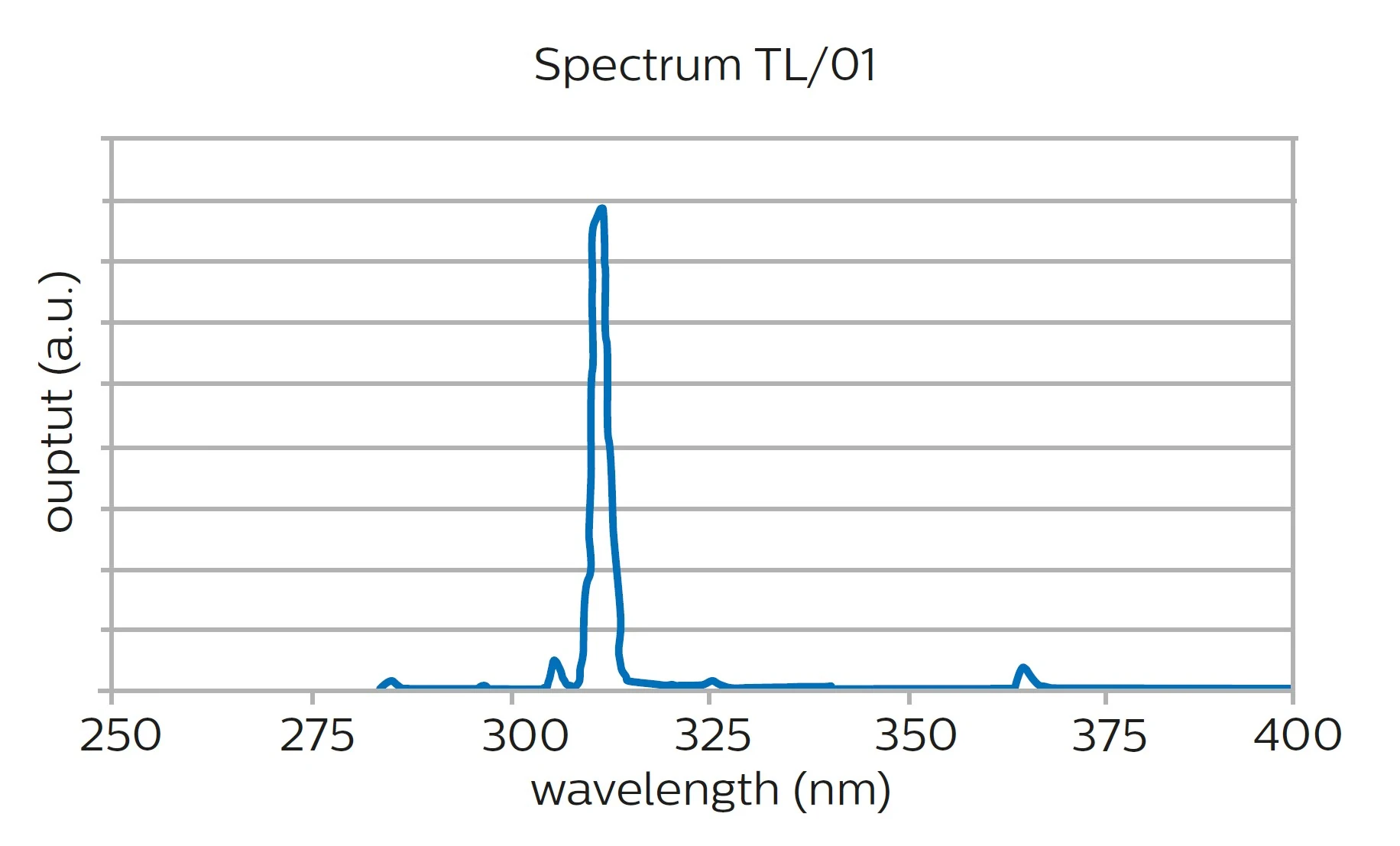
Background to the UVB 311 nm narrow-band spectrum
In the search for a UV spectrum that is both particularly effective and associated with few side effects, countless clinical studies have been carried out over the last 30 years. The highly selective UV-B (311 nm) narrow-band spectrum has now been shown to be particularly beneficial for a wide range of skin conditions, such as the treatment of psoriasis, atopic dermatitis and vitiligo. National and international medical guidelines favour the UV-B (311 nm) narrow-band spectrum over other UV spectra due to its efficacy, low risk profile, user-friendliness and availability.
The term ‘UV-B (311 nm) narrowband spectrum’ usually refers to the radiation emitted by the so-called TL01 lamps manufactured by Signify (formerly Philips). These lamps have contributed to global standardisation.
Partial or whole-body radiation therapy
UV irradiation is carried out using full-body cabins, partial-body units or small handheld devices. On the one hand, the device should be as large as necessary to cover all affected skin lesions. On the other hand, it should be as small as possible to protect unaffected areas of skin from UV irradiation.
Large UV irradiation devices are technically complex and are primarily found in hospitals, doctors’ surgeries and outpatient facilities. Smaller devices, and in particular hand-held ones, can also be used at home and save the user a great deal of effort over the course of the treatment. Smaller devices can also be used to treat larger individual lesions by treating the areas in sections.
UV monotherapy or combination therapy
UV phototherapy can be administered as monotherapy or as part of a combination therapy. The aim of combination therapy is to enhance the effect of UV phototherapy and achieve faster treatment success. In balneophototherapy, phototherapy is combined with brine baths. PUVA treatment involves the use of photosensitising agents, which are administered either systemically (oral medication) or topically (as a bath or cream). In addition to these two classic combination therapies, there are many other variants involving various conventional medicines and biologics.
The potentiating effect of combination therapies is generally accompanied by increased risks and side effects. Furthermore, unintended interactions between the treatments may occur. Combination therapy must therefore always be carried out under strict medical supervision.
Residual risk of skin cancer
It is generally accepted that excessive UV exposure can increase the risk of skin cancer. For many years, this led to reservations about UV therapy. A number of retrospective studies on this issue are now available. A systematic review published in 2021 analysed five cohort studies involving around 230,000 patients, half of whom were treated with UV phototherapy and the other half served as a control group. The review found no statistically significant increase in the risk of skin cancer for the UV-B (311 nm) narrow-band spectrum. Even upon closer examination of skin type (different ethnic origins) or the cumulative duration of treatment, no significantly increased risk could be identified.
Biologics
Thanks to the introduction of biologics, there are now more options for treating skin conditions such as psoriasis. Biologics are medicines produced using genetic engineering. They act in a similar way to certain proteins in the body and specifically target the immune system. This is why they are often very effective.
However, biologicals are not suitable for every patient. Many factors play a role in the decision, for example:
- the type and severity of the condition
- the stage of the disease and any comorbidities
- individual tolerance
- the patient’s personal preferences
UV phototherapy therefore remains an important form of treatment – even though it is no longer used as widely as it once was. UV therapy may be appropriate:
UV phototherapy as an alternative to biologics
- for short-term flare-ups of psoriasis,
- when biologics cannot be used (e.g. during pregnancy or whilst breastfeeding),
- when biologics are not tolerated, or
- when patients do not wish to take systemic medication.
UV phototherapy in addition to biologics
- as a short-term, complementary UVB treatment for individual remaining areas of skin
Finally, the cost of biologics also plays a role, as these are significantly higher than those of UV phototherapy. The availability of biologics and the extent to which costs are covered by health insurance therefore vary from country to country.